
What Politics Misses: Migration, Psychology, and the Stories We Need to Tell
Posted by IMIX on June 3, 2026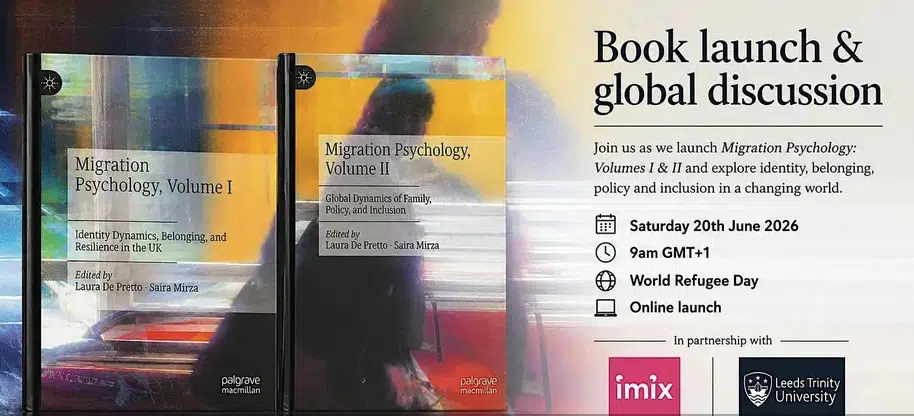
At IMIX, we believe that the way stories are told about migration shapes public understanding and ultimately, policy and lives. We’re always glad to amplify work that approaches migration with the depth and humanity it deserves.
Saira and Dr Laura from Leeds Trinity University are launching a two-volume edited collection, Migration Psychology, on World Refugee Day (20 June 2026) and they approached us to collaborate. We’re pleased to be supporting their launch event and sharing their thinking here. This guest post sets out why they believe psychology offers a vital and underused lens for understanding migration, and why the stories we tell about it matter.
By Saira and Dr Laura
Migration has always been part of human life. Across time and place, people have moved in search of safety, opportunity, family, and belonging. Communities have been built through shared histories of movement, and identities have long been shaped by encounters across cultures and borders.
Yet migration is increasingly discussed as though it is exceptional: something sudden, disruptive, and fundamentally problematic. Public debate in the UK and beyond frames it through the language of crisis. Political conversations focus on numbers, borders, and control, reducing complex human experiences to questions of management and containment.
What the crisis narrative leaves out
What gets lost in this process are the emotional and psychological realities of migration: the uncertainty that accompanies movement, the experience of adaptation, the grief that can come with displacement, and the resilience required to rebuild a life somewhere new. At the same time, migration can create opportunities for growth, connection, and renewal. It can involve the building of new communities, the reshaping of identities, and new ways of understanding ourselves and others. For many, it is not only a story of challenge, but one of agency, hope, and possibility.
Why the political climate makes this urgent
These realities are inseparable from politics. The language used by politicians and in the media shapes how communities understand one another, and affects how migrants experience everyday life. In the UK, the rise of increasingly hostile immigration narratives has intensified this climate. For many migrant communities, this creates a sense of precarity that extends well beyond formal immigration policy. Even when legal status is secure, belonging can feel uncertain and safety conditional.
What psychology brings to the conversation
Psychology offers an important way into these experiences. It draws attention to how wider social and political conditions are lived and felt, and invites different questions: what does prolonged uncertainty do to a person’s wellbeing? How does exclusion shape identity and relationships? What does resilience look like when people are rebuilding their lives while navigating systems that both support and marginalise them?
About the books
These questions sit at the centre of our recently published two-volume collection, Migration Psychology, Volume I: Identity Dynamics, Belonging & Resilience in the UK and Migration Psychology, Volume II: Global Dynamics of Family, Policy, and Inclusion. Developed at Leeds Trinity University and published by Palgrave Macmillan, the books bring together international contributors from across the social sciences to explore migration through the lens of lived experience. Contributors examine questions of identity, belonging, displacement, trauma, and connection, while situating these experiences within broader structures including borders, institutions, and historical inequalities.
A central aim of both volumes is to move beyond narratives that position migrants only through suffering or vulnerability. Those experiences matter and must be acknowledged, but they are only part of the story. Migration also involves agency, creativity, resistance, and the everyday work of building community and sustaining hope.
Why we’re partnering with IMIX
This commitment to centring lived experience is one of the reasons we are so pleased to be partnering with IMIX for our book launch. IMIX’s work focuses on challenging dehumanising narratives around migration by supporting more ethical, accurate, and human-centred storytelling. Their commitment to amplifying the voices of people with lived experience reflects many of the values that shaped this project from the beginning. Both IMIX and Migration Psychology are grounded in the belief that how we tell stories about migration matters, because those stories shape public understanding, political responses, and ultimately the lives of the people at the centre of them.
Join us on World Refugee Day
On Saturday 20 June 2026, to mark World Refugee Day, we will be launching Migration Psychology in partnership with IMIX – book tickets here. It feels especially meaningful to mark the publication of these books alongside an organisation so deeply committed to changing the migration conversation in the UK.
At a time when migration continues to dominate political debate, there is a need for more thoughtful, more humane ways of engaging with it. That begins with listening carefully to lived experience and recognising migration not as an abstract political issue, but as a deeply human one.